
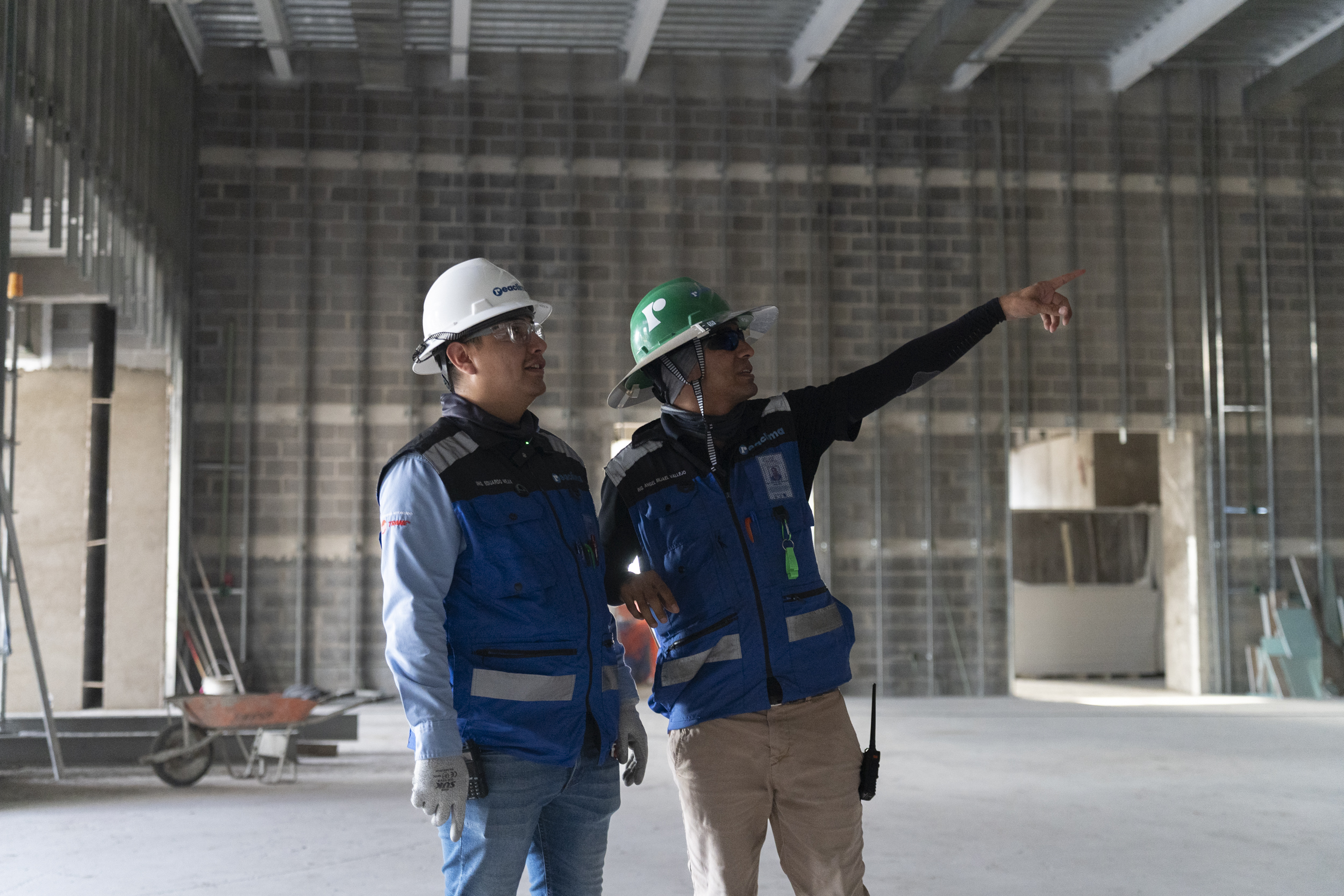
One network, many zones: Engineering VRF and direct expansion systems for facilities with simultaneous thermal demands.
When the problem is not tonnage, but simultaneity
In some facilities, the number that matters is not total thermal load, but how that load is split up. A
corporate building with façades facing different directions, a car dealership with a glass showroom and a
service workshop, a hotel with unevenly occupied rooms: in these cases, adding up refrigeration tons says
little about what the system actually has to solve.
What matters is simultaneity: how many zones call for cooling at the same time, how many call for heating,
how many sit empty, and how much that shifts through the day. An east-facing façade and a west-facing
one never ask for the same thing at the same hour. A sun-exposed glass showroom and a workshop full of
diagnostic equipment work under different conditions even under one roof.
The ASHRAE Handbook — HVAC Systems and Equipment identifies variable refrigerant flow systems as the
family built for exactly this: fractional loads that vary and do not line up in time. This is not about calculating
one number correctly. It is about anticipating a pattern.
VRF: the three decisions that define the system
A VRF system (called VRV in much of the industry, Variable Refrigerant Flow) carries refrigerant from one
or more outdoor units to several indoor units through copper piping, adjusting how much refrigerant each
zone gets based on what that zone needs at that moment. The principle is well known. Three things decide
whether the system actually performs.
The first is how many pipes the circuit runs on: two or three. In a two-pipe system, every zone works in the
same mode: either all cooling, or all heating. In a three-pipe system, with branch selector boxes, one zone
can cool while another heats at the same time. Three-pipe costs more to install. The decision is not about
the catalog: it is about whether the building genuinely needs cooling and heating at once.
The second is how the piping is routed. Every VRF system has certified limits: total pipe length, distance to
the farthest indoor unit, maximum elevation between outdoor and indoor units. Going past those limits
lowers system capacity and affects oil return to the compressor. AHRI Standard 1230 sets the conditions
under which this equipment is performance-certified. Outside those limits, there is no guarantee the system
delivers what its data sheet promises.
The third is how zones are divided: how many, how they are grouped, which unit serves each one. Too
much division multiplies cost and failure points without real benefit. Too little wastes the system’s main
advantage. This is where the designer’s experience matters more than the spec sheet
Heat recovery: the advantage that justifies the system
The strongest technical reason to choose VRF in a mixed-use building is heat recovery. In a three-pipe
system, the heat pulled out of a zone that is cooling is not dumped outside: it is sent to zones that are asking
for heat at that same moment. The system stops acting like two separate machines and starts moving heat
from one part of the building to another.
The savings depend on how often the building needs cooling and heating at the same time. If every zone
always cools together, heat recovery does nothing. If the building has a perimeter and a core, opposing
façades and uneven occupancy, there can be many hours a year with simultaneous cooling and heating
demand — and that is where the real savings show up. The ASHRAE Handbook — HVAC Systems and
Equipment recognizes this capability as what sets VRF apart from conventional direct expansion.
That is why heat recovery is not something you simply buy: it is something you verify beforehand. Without
a real look at how the building is actually used, the extra cost of a three-pipe system may never pay for
itself.
Direct expansion: where it is still the right answer
Direct expansion —refrigerant exchanges heat directly with room air, no water loop in between— remains
the right solution in many cases. Packaged or rooftop units for warehouses and production areas with
uniform load. Ducted split systems for zones with specific filtration or air distribution needs. Standalone
units for spaces that run on a different schedule than the rest of the building.
Its advantage is simple: fewer components, faster installation, easier maintenance, and the ability to run
one zone on its own without depending on the rest of the system. If an area has its own schedule —a small
server room, a guard booth, an office working off-shift— a standalone unit avoids running an entire large
system just to serve that one zone.
The right question is not which system is better. It is what load pattern, what schedule and what
maintenance the facility actually has.
Refrigerant as a design constraint
In direct expansion and VRF systems, the refrigerant does not stay in a machine room: it runs through piping
that crosses occupied spaces. That is why choosing the refrigerant is not a data-sheet detail. It is a design
decision with safety implications.
ASHRAE Standard 34 classifies refrigerants by toxicity and flammability. ASHRAE Standard 15 sets how much
refrigerant is allowed based on the size of the smallest occupied space the system serves. In a VRF system
with long piping and high charge, that limit can force a different routing, split the system into separate
circuits, or require detection and safety ventilation.
There is one more thing to weigh: the industry is changing refrigerants. The Kigali Amendment to the
Montreal Protocol sets an international schedule to phase down hydrofluorocarbons, and the sector is
shifting toward A2L alternatives —mildly flammable— that call for specific installation precautions. In
Mexico, NOM-023-ENER-2018 sets efficiency limits for split air conditioners, including variable-flow inverter
units, and ASHRAE 90.1 sets the minimum efficiency levels for system design. Specifying a system today
without looking at where refrigerant regulation is headed means designing equipment that ages before its
time.
How to choose between VRF and direct expansion
VRF makes sense when a building has zones with different demands at the same time: opposing façades,
mixed use, uneven occupancy through the day. That is where per-zone modulation —and, when the
building justifies it, heat recovery— make the difference.
Direct expansion makes sense when the load is uniform and steady, when a zone needs to run on its own
without depending on a central system, or when the process needs tighter humidity control than VRF
handles well. It also makes sense when the facility cannot tolerate any interruption: there, the redundancy
of a centralized plant matters more than VRF flexibility.
Neither system is better in the abstract. The choice depends on the building’s real load pattern, not on what
is trending or what costs less upfront.
A technical ally for the mixed-use facility
The difference between a system that works and one that gets in the way is decided before the first unit
goes in: reading the simultaneity pattern correctly, the refrigerant circuit architecture, routing within
certified limits, and zoning that matches how the building is actually used.
Reaclima designs, supplies, installs and commissions VRF and direct expansion systems. If your next project
has zones with different thermal demands, let’s talk.


