
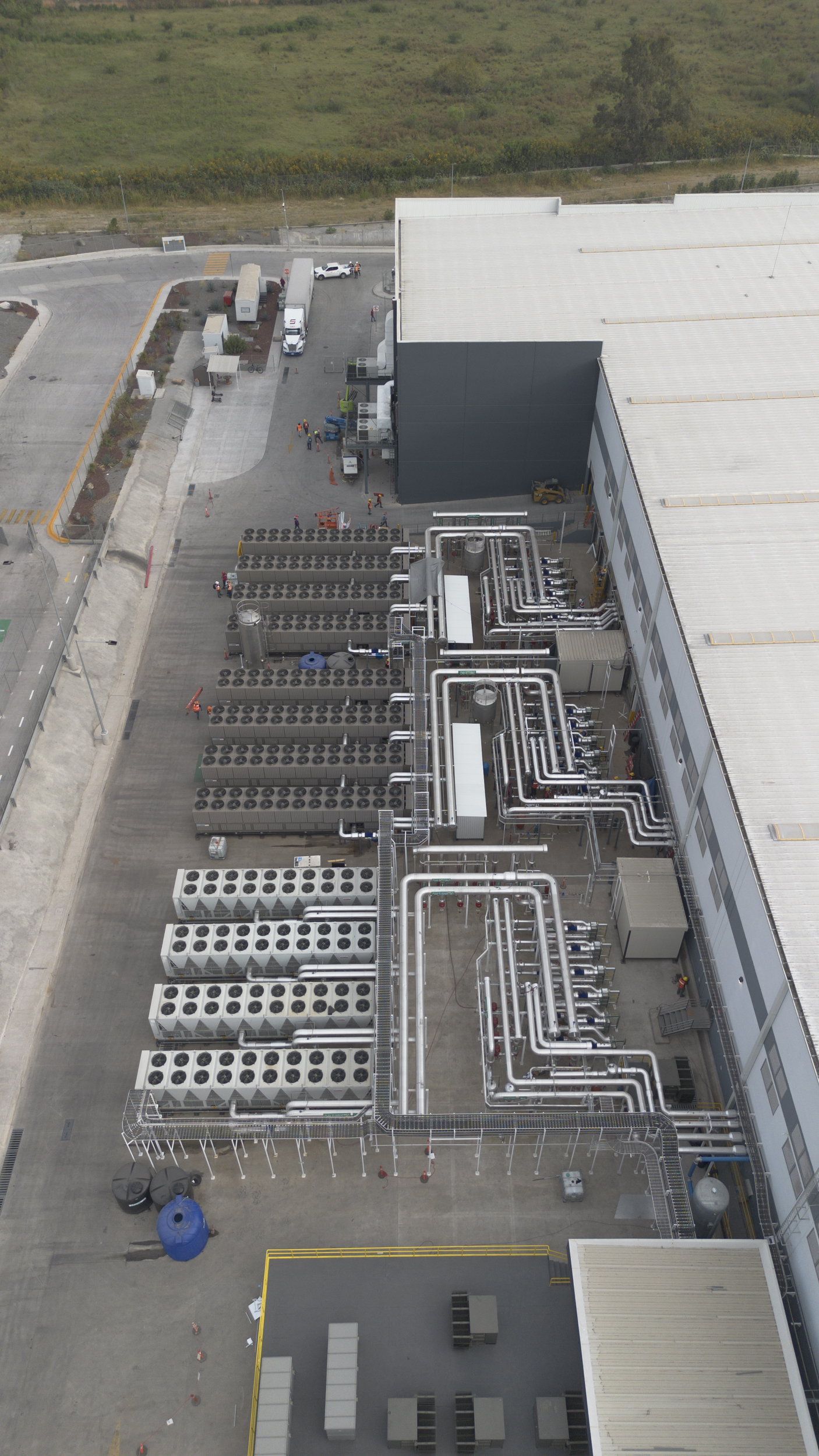
Choose the refrigerant for the next decade: A chiller runs for up to twenty years. Its refrigerant defines the machinery room and how easy it will be to service.
Why is the refrigerant an engineering decision, not a purchasing one?
When chillers are compared, the conversation centers on capacity, efficiency and price. The refrigerant appears on the data sheet as one more line. That is a mistake of perspective.
Mexico froze its HFC consumption in 2024 and will start reducing it in 2029. A chiller installed today that runs for twenty years will live through every step of that schedule, up to the 80 % reduction in 2045.
Over that time, its refrigerant will have to be available for every service call, comply with the rules in force and coexist with the machinery room where it was installed. If the market abandons it halfway through its service life, the owner bears the cost.
That is why the refrigerant is decided during engineering. That is where the compressor type, the machine size, the machinery room conditions and the safety systems are defined. Changing it later costs far more than choosing it well from the start.
What is the Kigali Amendment and what schedule does Mexico follow?
Hydrofluorocarbons (HFCs) replaced the refrigerants that damaged the ozone layer. They do not harm it, but they have a high global warming potential (GWP). R-134a, common in screw and centrifugal chillers, warms the atmosphere 1,430 times more than the same amount of CO₂ over a hundred-year horizon.
In 2016, the Parties to the Montreal Protocol agreed in Kigali, Rwanda, to gradually reduce HFC production and consumption. Mexico ratified the amendment in 2018 and follows this schedule:
· Baseline. Average HFC consumption from 2020 to 2022, plus 65 % of the HCFC baseline.
· 2024. . Consumption freeze.
· 2029. 10 % reduction.
· 2035. 30 % reduction.
· 2040. 50 % reduction.
· 2045. 80 % reduction.
In May 2026, SEMARNAT, Mexico’s environment ministry, reaffirmed the goal of cutting HFC consumption by 80 % by 2045.
There is an important nuance. Kigali does not ban operating equipment that is already installed. What it limits is the amount of HFCs the country can produce and import. With each step there will be less high-GWP refrigerant to charge new equipment and service existing units.
What is changing in the chillers built today?
The fastest change does not come from Mexican regulation, but from the market where many of the chillers installed in the country are designed.
In the United States, new comfort-cooling chillers manufactured or imported since January 1, 2025 can no longer use refrigerants with a GWP of 700 or more. This is the Environmental Protection Agency (EPA) Technology Transitions rule. For industrial process chillers, the general date is January 1, 2026, and 2028 for very low-temperature units. The revision EPA published in May 2026 relaxed deadlines for other sectors, not for comfort-cooling chillers.
Manufacturers have already adjusted their lines. Carrier offers its AquaForce 30HX water-cooled screw chiller with R-513A. Trane equips its CenTraVac centrifugal chillers with R-1233zd(E) or R-514A, both with a GWP below 2. Daikin offers screw and centrifugal chillers with R-513A or R-1234ze.
For a project in Mexico, the consequence is practical. The supply of new chillers is already moving toward these refrigerants, even though local regulation moves at a different pace.
Why does it matter more in industry and data centers?
In an office building, the chiller cools during working hours. In a manufacturing plant, a hospital or a data center, the chilled water plant runs many more hours a year and, in some cases, without interruption.
That changes the weight of the decision. More operating hours mean more service calls over the equipment’s life and, with them, more occasions when the refrigerant must be sourced. In a production process, the chiller is part of the line: if a service call is delayed because refrigerant is scarce, the cost is not only a cooling problem.
Industrial equipment is also large and is installed in machinery rooms that are designed only once. Whatever that room did not anticipate is expensive to add later.
Which refrigerants replace the usual ones?
It depends on the type of chiller. The industry separates them by the pressure at which the refrigerant operates.
· Medium pressure (screw and centrifugal chillers that use R-134a today). ). R-513A is a non-flammable blend with a GWP of 631. It is nearly compatible with R-134a designs, with slightly lower efficiency. R-1234ze(E) has a GWP close to zero, but it is mildly flammable and needs compressors with greater displacement for the same capacity.
· Low pressure (centrifugal chillers that used R-123) R-1233zd(E) and R-514A have a GWP below 2. The first is non-flammable and of lower toxicity. The second has the same toxicity class as the R-123 it replaces.
The GWP values for R-134a and R-513A come from the IPCC Fourth Assessment Report (AR4), the reference used by the Kigali Amendment. The others come from manufacturer information.
There is no universal replacement. Each option changes something: efficiency, machine size or the safety requirements of the room where it is installed.
What do A1, A2L and B1 mean?
ANSI/ASHRAE Standard 34 classifies each refrigerant with a letter and a number.
· The letter indicates toxicity. A means lower toxicity; B, higher toxicity.
· The number indicates flammability. 1 means no flame propagation; 2L, mildly flammable; 2 and 3, higher flammability.
A2L refrigerants are the big change. They are hard to ignite and, if they do ignite, the flame moves slowly: the standard limits their burning velocity to 10 centimeters per second. Even so, they are not treated like an A1. They need their own design rules.
The B1 class of R-514A is not new. It is the same as R-123, which the industry has handled for decades in machinery rooms with detection and ventilation.
What changes in the machinery room?
ANSI/ASHRAE Standard 15 sets out how to install refrigeration systems safely. For large chillers, the machinery room is the central point.
· Detection. The room must have a refrigerant detector, placed where a leak would concentrate, that triggers an alarm and mechanical ventilation.
· Ventilation. Mechanical ventilation must remove leaked refrigerant before it reaches a dangerous concentration.
· Instalación eléctrica. If the room houses A2L or B2L refrigerants, the standard allows compliance through ventilation and detection, or by classifying it as a hazardous electrical location (Class I, Division 2).
There are other physical consequences. A chiller using R-1234ze(E) may need more space than an equivalent R-134a unit. A low-pressure centrifugal chiller runs with its evaporator below atmospheric pressure, so it needs a purge system to remove any air and moisture that get in.
All of this is easy to solve on the drawings. In a finished building, every change means demolishing, relocating or redesigning.
What happens to chillers already running on R-134a or R-123?
They can keep running. None of the rules described requires removing equipment that works.
What changes is the environment around them. R-123 is an HCFC, a family the Montreal Protocol phases out in countries like Mexico by 2030, with a limited allowance for servicing until 2040. R-134a is an HFC subject to the Kigali schedule. In both cases, it is worth knowing how much service life the chiller has left and planning its replacement in time.
Some manufacturers offer conversions to low-GWP refrigerants for certain models. Whether they are viable depends on the unit, and that assessment belongs to the manufacturer.
What should be decided during engineering?
In a new project or a plant expansion, these are the decisions worth closing before purchasing:
· The refrigerant and its safety class. Written into the specification, not left to the supplier’s proposal.
· The machinery room. . Detection, ventilation, electrical installation and space, designed for the chosen refrigerant.
· Real efficiency. Compare part-load performance with the specific refrigerant, because it varies from one option to another.
· Future service. Confirm that refrigerant, parts and trained technicians will be available in the region throughout the equipment’s service life.
· Operation. Make sure the staff who will run the plant are trained on the refrigerant and its alarms.
What should you ask when reviewing a proposal?
If you are comparing proposals for a chilled water plant, four questions help tell them apart:
· Which refrigerant does the chiller use, and what is its GWP?
· What is its safety class under ASHRAE 34?
· Does the machinery room design comply with ASHRAE 15 for that class?
· How available will that refrigerant be for service ten years from now?
A proposal that answers all four clearly has already done the engineering work. One that does not is leaving the decision for later.
A decision for twenty years
The refrigerant is not visible in the finished building, but it stays with the equipment throughout its life. It is one of the engineering decisions with the most consequences and the least visibility.
At Reaclima we design, supply and install chilled water plants and HVAC systems for industry, data centers and hospitals. The refrigerant is defined during engineering, together with the machinery room that will house it, and it is verified during testing and start-up.
If your next project is already in the engineering stage, let’s talk.


