
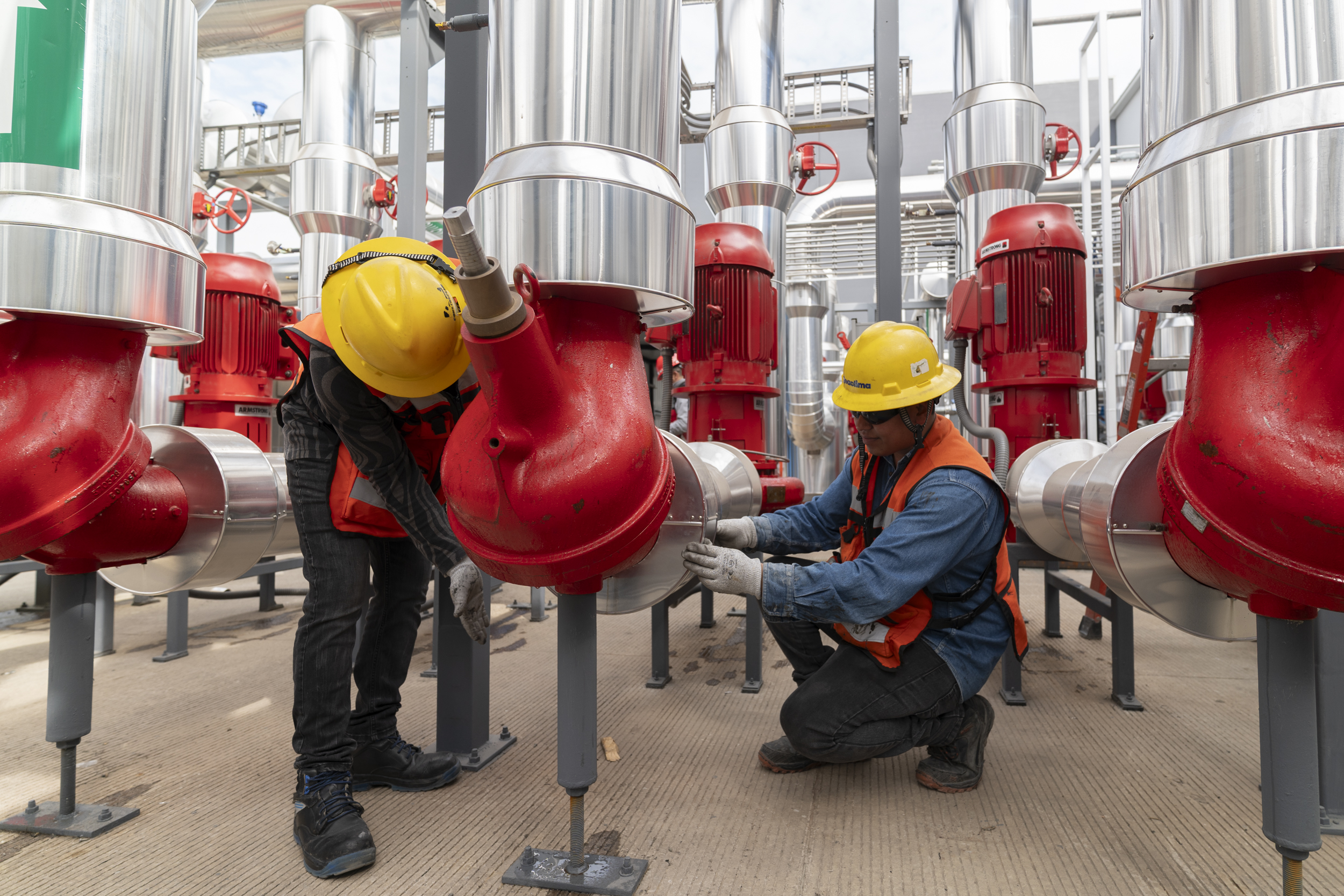
Execution and Installation of Liquid Cooling Infrastructure: Materials, Processes and Quality Control
Introduction: From conceptual engineering to operational reality
The transition from an engineering design to an operational system in a mission-critical facility demands millimetric precision, thorough quality control, and commissioning protocols that verify actual performance against design specifications. Liquid cooling systems present additional complexities compared with conventional air-conditioning installations: they operate with fluids in close proximity to high-value electronic equipment, require hermetic connections at multiple interface points, and depend on the structural integrity of components subjected to repeated thermal cycles.
According to the Uptime Institute's Annual Outage Analysis 2024, the average cost of a data center downtime event exceeds $9,000USD per minute, and more than 50% of severe outages originating in mechanical infrastructure are linked to cooling-system failures. This figure is the metric that justifies the rigor the discipline demands at every stage of the installation process.
Liquid cooling installation is a discipline that combines detailed engineering, rigorous material specification, execution under international codes, and systematic commissioning prior to IT-equipment energization. This article presents the technical principles and quality criteria that govern professional project execution in mission-critical data centers, drawing on Reaclima's five-plus decades in industrial HVAC and on hyperscale projects delivered in Mexico.
As-built survey and BIM coordination: Eliminating interferences before construction
Before field work begins, a professional installation contemplates a three-dimensional survey using LiDAR (Light Detection and Ranging) scanning. The technology captures the exact geometry of the space —including structural elements, cable trays, existing piping, HVAC ducts, fire-protection systems, and mechanical equipment— with typical accuracy of ±2 mm.
The LiDAR point cloud is processed with BIM software (Autodesk Revit, Bentley MicroStation, or equivalent platforms) to build a three-dimensional digital model of the site. On top of that as-built model, the engineering team integrates the design of primary piping (FWS), secondary piping (TCS), CDU locations, rack manifolds, quick disconnects, and pipe supports.
BIM software runs clash detection to identify geometric conflicts between the proposed design and existing elements. Examples include crossings between refrigerant piping and electrical cable trays, interference between rack manifolds and smoke-detection systems, and conflicts between pipe supports and pre-existing structural anchors.
Resolving these conflicts during the modeling phase —before cutting pipe or drilling— meaningfully reduces installation time. Industry reports, including Dodge Construction Network's BIM Adoption Report, document reductions on the order of 30% to 40% in projects where BIM coordination is integrated from design. The practice also eliminates rework and mitigates the risk of damage to existing infrastructure during construction.
In hyperscale projects where Reaclima has participated, BIM coordination has systematically identified critical interferences between chilled-water piping and existing data-center infrastructure before construction began, preventing disruptions during the build phase.
Material specification: Piping, fittings and coolants
The durability and reliability of liquid cooling systems depend on the correct selection of materials compatible with the coolant, operating pressure and temperature conditions, and applicable building codes.
Piping and fittings
Piping for liquid cooling circuits is selected based on fluid type, operating pressure, and location (in-rack, below raised floor, or overhead).
Primary piping (FWS) — Chilled water:
Black steel Schedule 40 with internal epoxy lining for large diameters (2"–6"). The lining prevents corrosion and reduces internal roughness, minimizing friction losses.
Stainless steel 304/316 for installations where water quality may vary in pH or conductivity. Higher cost, extended service life.
CPVC Schedule 80 applicable in untreated-water circuits. Advantages: low weight, corrosion resistance, ease of installation. Limitation: maximum operating temperature of 82 °C (180 °F).
Secondary piping (TCS) — Rack circuits:
Copper Type L is the industry standard for secondary circuits. High thermal conductivity, excellent brazeability, and universal availability. Typical diameters: 1/2" to 2".
Corrugated flexible stainless steel for connections that require flexibility (CDU drops and rack manifolds). Absorbs thermal expansion without transferring stress to the joints.
Multilayer pipe (PEX-AL-PEX) made of cross-linked polyethylene with an intermediate aluminum layer. Advantages: low weight, flexibility, corrosion resistance. Limitation: maximum pressure of 10 bar.
Joints and fittings
Brazed vs. mechanical joints. Permanent joints in copper are produced by brazing with silver alloys. Brazing operates at elevated temperatures and creates a metallurgical joint that meets or exceeds the mechanical strength of the base tube. The reference standard is AWS D10.13/D10.13M — Recommended Practices for the Brazing of Copper Tubing and Fittings, which sets out the principles of surface preparation, flux, controlled heating, capillary feeding, and natural cooling.
Mechanical fittings (flare fittings, compression fittings) are reserved for points that require periodic disassembly for maintenance. Compression fittings use brass or stainless-steel ferrules tightened against the tube by threaded engagement, sealing without brazing.
Quick Disconnects (QDs). Rack manifolds integrate quick disconnects that enable server hot-swap without draining the entire system. Data-center-grade couplings feature: bidirectional automatic shut-off valves —both halves seal upon disconnect, containing fluid on each side—; redundant sealing with EPDM or Viton O-rings; positive locking against accidental disconnects from vibration or handling; and bodies in corrosion-resistant alloys.
Specialized thermal-management manufacturers for data centers offer certified couplings with operating pressures covering the entire range required by primary and secondary circuits, with minimal residual leakage per manufacturer specification.
Coolants and water treatment
Primary circuits (FWS). Chilled water requires chemical treatment to prevent corrosion, scaling, and biological growth. The typical program includes corrosion inhibitors (molybdates, nitrites, or azoles that form protective films on metal surfaces); pH control in a slightly alkaline range to minimize galvanic corrosion; periodic biocide application for bacterial and algal control; and cartridge filtration to remove sediment.
Secondary circuits (TCS). Fluids in direct contact with servers meet stricter requirements. The usual specification contemplates deionized water with 30-50% propylene or ethylene glycol, low electrical conductivity, and pH controlled in an alkaline range. Glycol lowers the freezing point and acts as a corrosion inhibitor. Formulations with antifoam additives and thermal stabilizers significantly extend fluid service life in operation.
Engineered dielectric fluids for immersion or applications where contact with electrical components is likely. The historical 3M Novec line was discontinued in 2025 as part of 3M's PFAS exit; the current market includes alternatives from specialized manufacturers that require handling with personal protective equipment and sealed-container storage to prevent moisture contamination.
Pipe thermal insulation
Chilled-water piping must be insulated to prevent condensation and thermal losses. The usual solutions are closed-cell elastomer —variable thickness depending on diameter, with integrated vapor barrier— or fiberglass with vapor barrier for large-diameter primary piping, with aluminum or PVC jacketing for mechanical protection
Insulation must be continuous, with no discontinuities at elbows, tees, or valves. Wall and floor penetrations require hermetic sealing to prevent humid-air bypass.
Installation processes: Work sequence and inspection points
Work execution follows a controlled sequence that minimizes interferences between trades and preserves access for quality inspections.
Phase 1: Pipe supports and structural anchors
Liquid cooling piping carries significant loads when filled. As a reference, a 2" Type L copper pipe weighs approximately 1.45 kg/m empty and 3.45 kg/m when filled with water, per the nominal dimension of ASTM B88. Supports must be sized for the filled condition plus a safety factor appropriate to the application.
Supports commonly used in this type of installation are clevis hangers, adjustable clamps, and trapeze hangers made of galvanized or stainless steel. Anchors to concrete slabs are executed with chemical (epoxy) or mechanical (wedge) anchors certified for the tensile load specified by the anchor manufacturer.
Support spacing follows ASME B31.9 — Building Services Piping: copper 1/2"-3/4", support every 1.8 m; copper 1"-2", support every 2.4 m; steel 2"-4", support every 3.0 m.
Phase 2: Pipe routing and joining
Pipe routing follows the BIM model. Key control points: minimum slope toward drain points to allow full purging during maintenance; automatic vent valves at high points to evacuate air during filling and operation; and isolation valves (ball or butterfly) at strategic positions to section the system for maintenance without full drainage.
Brazing is performed by personnel certified to AWS D10.13/D10.13M — Recommended Practices for the Brazing of Copper Tubing and Fittings. Industry practice in mission-critical installations contemplates systematic visual inspection of brazed joints, verifying alloy penetration, absence of porosity or cavities, fillet uniformity, and removal of flux residue.
Phase 3: CDUs, pumps, and mechanical equipment
Coolant Distribution Units are installed at the locations defined in the design, typically in hot aisles or dedicated mechanical rooms. Large-capacity CDUs (2 MW class) reach weights on the order of several tons in operation with coolant, which demands structural verification of the floor or slab supporting them.
Installation contemplates precision leveling with digital instruments —deviation can cause inadequate circulation or air-pocket formation—; flange alignment between CDU and supply/return piping to avoid mechanical stress on the joints; three-phase electrical connection of variable-speed pumps with overload protection and soft start to prevent current spikes; configuration of variable frequency drives (VFDs) with acceleration and deceleration ramps consistent with the hydraulic inertia of the system; and BMS or DCIM integration through temperature, pressure, flow, and coolant-quality sensors for real-time visualization.
Phase 4: Rack manifolds and server connections
Manifolds are mounted at the top or rear of the rack, depending on server configuration. Specialized commercial manifolds integrate quick disconnects spaced to match the configuration (1U, 2U, blade); temperature sensors at every supply and return port; per-server isolation valves; and leak detection via moisture sensors.
Cold-plate-to-manifold connections follow the server manufacturer's protocol, which typically specifies torque on quick disconnects, connection sequence, and visual confirmation of positive engagement.
Hydrostatic testing and commissioning: Verifying integrity before energization
Liquid cooling commissioning takes as reference the protocols defined in ASHRAE Guideline 1.1 — HVAC&R Technical Requirements for the Commissioning Process and the equipment manufacturer's specifications.
Hydrostatic pressure testing
Hydrostatic testing verifies system integrity before introducing costly operating fluids or energizing IT equipment. Industry-recognized practice contemplates four conceptual stages: internal pipe cleaning, controlled filling of the system with test water, pressurization to a multiple of the maximum operating pressure —the customary factor under ASME B31.9 is 1.5×, sustained for the period defined by specification— and finally, systematic leak inspection at joints, fittings, flanges, and valves.
Leak detection combines visual inspection (droplet formation or moisture stains), use of absorbent paper at critical joints, and, where appropriate, acoustic detection in nitrogen-pressurized circuits. Any leak detected requires system depressurization, repair of the defective joint, and full repetition of the hydrostatic test until the acceptance criterion is met.
Functional commissioning of equipment
Once hydrostatic testing is approved, functional commissioning covers four fronts: filling with operating fluid after system drying and verification of glycol concentration; flow and differential-pressure testing with measurement at test points and balancing-valve adjustment to ensure uniform distribution among racks; instrumentation verification and VFD response to control signals (4-20 mA, Modbus, BACnet), including fault simulation to validate isolation protocols and alarms; and thermal-load testing that verifies achieved Delta T, actual versus design PUE, and thermal stability of the system under sustained load.
Commissioning closeout is documented through test certificates, measurement reports, and acceptance protocols that constitute the technical traceability of the project.
Conclusion: Precision in execution, reliability in operation
Liquid cooling installation in mission-critical data centers does not tolerate improvisation. Every joint, every connection, and every isolation valve is a potential point of failure that can compromise the operational continuity of high-value processing infrastructure.
Reaclima's five-plus decades in industrial HVAC support the capacity to accompany liquid cooling projects in data centers from design through commissioning, applying the technical principles described in this article: as-built survey, BIM coordination, tier-1 material specification, brazing under international standards, and systematic commissioning prior to IT-equipment energization.
Does your liquid cooling project require technical support to reach the quality standards expected of mission-critical installations? Let's talk.


