
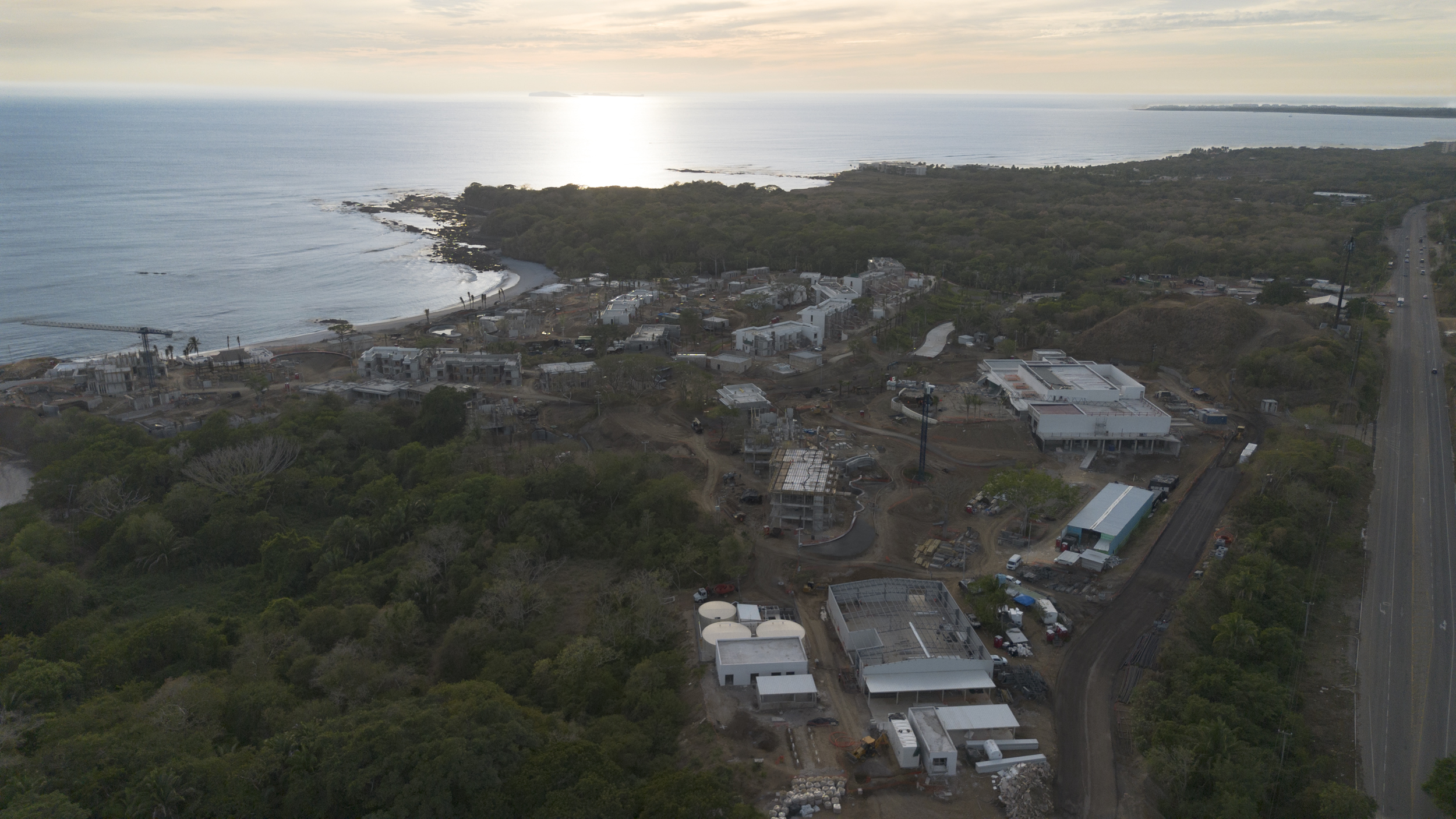
A design does not relocate: When the same project is built in a different city, the thermal design is not copied, it is recalculated.
Why is the data center map in Mexico shifting?
For several years, digital infrastructure development in Mexico concentrated in a handful of locations. Querétaro absorbed close to half of the country’s installed capacity, and with it most of the sector’s engineering, construction and operating experience.
That pattern is changing. The Mexican Data Center Association has warned that Querétaro is approaching its operating limits in energy capacity and water availability. At Mexico Connect 2026, held in September in Mexico City, one of the central sessions addressed precisely how to scale development beyond that corridor, with participation from operators, equipment manufacturers and developers.
The reading for those who build is direct: the next large-scale projects will not all be in the same place. And that carries a technical consequence that is frequently underestimated.
The shift is not small in scale. Announced capacity for the coming years comfortably exceeds what operates in the country today, and a significant share of that volume will have to be built outside the corridor that absorbed the first wave. For engineering and installation firms, that means working in climates, elevations and regulatory frameworks they do not know by heart.
What changes technically when the city changes?
An identical building, with the same thermal load and the same use, needs a different design if it is built in another location. Not by preference of the designer, but because the outdoor conditions that govern the design are different.
The ASHRAE Handbook — Fundamentals devotes an entire chapter to climatic design information, with values by weather station. That is the source of the three figures that change when the site changes.
· Design wet-bulb temperature. Governs everything that rejects heat through evaporation. It determines how cold the water leaving a cooling tower can get.
· Design dry-bulb temperature. Governs everything that rejects heat directly to air. It determines the real capacity of an air-cooled condenser on the most demanding day of the year.
· Altitude. Governs air density, and with it the flow rate required to transport the same amount of heat.
All three vary considerably across Mexican territory. This is not fine tuning: these are differences of magnitude that translate into different equipment.
Why does wet-bulb govern heat rejection?
A cooling tower cannot deliver water colder than the outdoor air wet-bulb temperature. That is its physical floor. The entire tower design consists of deciding how close to that floor you want to get, and how much tower you are willing to pay for it.
When a project moves to a location with higher wet-bulb, the same tower delivers warmer water. And warmer condenser water means a chiller working against a greater pressure differential, consuming more energy per ton produced. The effect propagates backward through the whole system.
That is why design wet-bulb is not a weather figure: it is the starting point of sizing. A project that changed sites and kept its original tower selection begins with an energy penalty that will follow it through its entire service life.
There is a nuance worth understanding. Wet-bulb does not track dry-bulb. One location can be hotter than another and at the same time have a lower design wet-bulb, because the air is drier. The arid climates of northern Mexico favor evaporative cooling for exactly that reason: there is more margin between air temperature and the physical limit the water can reach.
The consequence is counterintuitive and worth stating plainly. Moving a project to a cooler city does not guarantee better tower performance. What matters is humidity, not how hot it feels.
How does altitude affect sizing?
This is the factor most frequently overlooked, and in Mexico it carries particular weight.
The locations where digital infrastructure is developed in the country sit at very different elevations. Mexico City is around 2,240 meters above sea level. Querétaro sits on the Altiplano, above 1,800. Guadalajara is near 1,600. Monterrey drops to roughly 540. Tijuana is practically at sea level.
Air at higher altitude is less dense. A cubic meter of air in Mexico City contains less mass than a cubic meter at sea level, and therefore carries less heat. The practical consequence is that moving the same amount of thermal energy requires moving more air volume.
That affects everything working with air. Tower fans deliver less mass per revolution. Air handling units need more flow for the same capacity. Air-cooled condensers lose capacity. And the motors driving all that equipment are sized differently.
The industry applies air density corrections starting at roughly 600 meters of elevation. Practically the entire central Mexican corridor sits well above that threshold. Equipment selected using sea-level tables and installed on the Altiplano does not deliver what its data sheet claims, and the difference is not marginal.
The problem compounds because the correction is not applied once. If air flow rises to compensate for density, pressure drop across ducts and coils rises with it, and so does fan power. Correcting altitude properly means reviewing the full chain —flow, duct, fan, motor and starter— not simply raising a number on the selection sheet.
It is also worth separating two cases that get confused. A project moving down in elevation has margin in its favor: equipment delivers more than expected and the risk is oversizing. A project moving up has margin against it, and that one is paid in performance from the first day of operation.
And what about water?
Water availability is the site condition that can invalidate an entire design fastest.
It is not only a question of whether water exists, but under what conditions it can be used. Permits, consumption quotas and seasonal restrictions vary by state and have been tightening in regions under greater water stress. An evaporative scheme perfectly viable in one location can prove impracticable two hundred kilometers away, not for lack of physical water but because of the framework governing its use.
That verification belongs to the preliminary design stage, not to detailed engineering. Discovering the restriction once equipment is already purchased leaves very limited options, all of them expensive.
How much of a design can be reused between locations?
More than it seems and less than one would like.
What does carry over is the architecture: the hydronic circuit scheme, the zoning strategy, the control logic, the redundancy topology, the operating and maintenance criteria. All of that is engineering work that is not lost when the site changes, and it is the reason a developer repeats a supplier across projects.
What does not carry over is equipment selection. Capacities, flow rates, motor power, heat transfer surface and water consumption are recalculated against the new site conditions. Keeping the original selection because the building is the same is the most expensive mistake in this transition, and the hardest to correct after commissioning.
The practical distinction is simple. The drawing of how the system works travels. The numbers used to purchase the equipment do not.
This difference also organizes the commercial conversation. When a developer asks to replicate a successful project in another city, what they are actually asking for is a replication of design criteria and achieved performance, not the bill of materials. Understanding that from the first meeting prevents cost expectations that cannot hold later.
What gets recalculated when the location changes?
This is the minimum verification before moving a design to a new site. None of these points depends on the supplier or the equipment brand: they are conditions of the land, and whoever reviews them before purchasing reaches commissioning without surprises.
- Outdoor design conditions. Wet-bulb and dry-bulb from the corresponding station, not from the nearest location with available data.
- Altitude correction. Air density applied to flow rates, fan selection and motor power.
- Heat rejection route. The choice between cooling tower, air-cooled condenser or hybrid configuration can reverse when the site changes, even with identical load.
- Water availability and quality. Determines whether the evaporative route is viable and what treatment it requires. Varies by region and by season.
- Local regulatory framework. Permits, water consumption limits and efficiency requirements applicable in the state.
None of these points is optional. Omitting a single one produces a system that works, but works worse than designed for every year it operates.
A technical ally for the project that changes location
The sector’s geographic expansion is good news for those who build. It is also an engineering test: it forces a distinction between which part of a design is transferable knowledge and which part is a specific answer to the conditions of one piece of land.
Reaclima designs, supplies, installs and commissions industrial HVAC systems, operating in Nuevo León, Saltillo, Chihuahua, Nayarit, Jalisco, Querétaro and Sonora. If your next project is built in a different location than the last one, let’s talk.


