
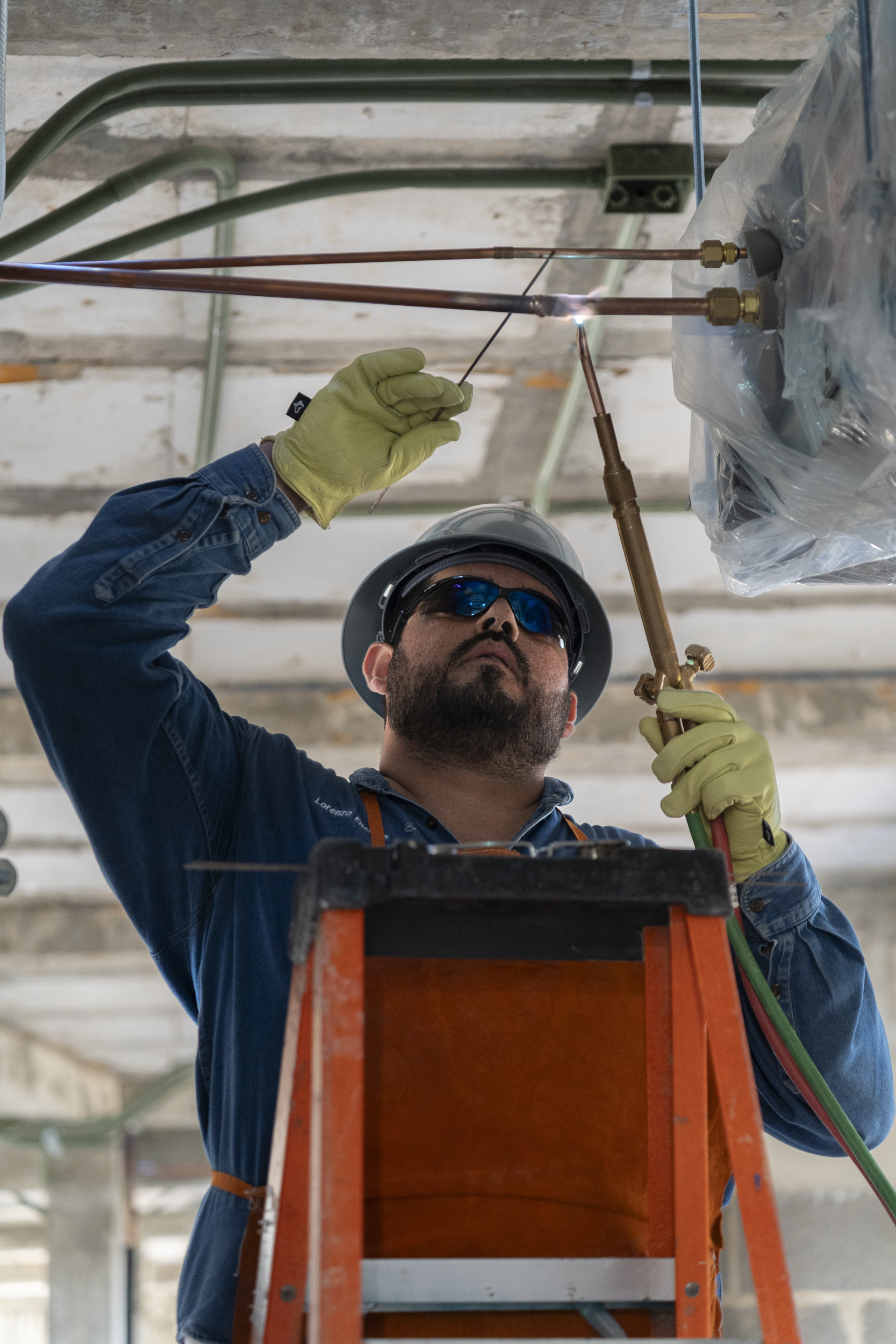
The real cost of deferring preventive maintenance in industrial HVAC and Liquid Cooling systems
The conversation about preventive maintenance in industrial HVAC and Liquid Cooling systems is often framed as a short-term budget discussion. Each month that scheduled inspection is postponed shows up as an immediate saving. The financial reality observed over the equipment service life is the opposite: the cost of deferring is greater than the cost of executing, once unscheduled downtime, premature equipment replacement, energy efficiency loss and — in regulated sectors — administrative exposure are summed.
This article explains why the arithmetic of deferral is always unfavorable, what international references codify the total operating cost structure for critical HVAC and Liquid Cooling infrastructure, and what reference figures allow the client financial decision-maker to read the OPEX line in front of them correctly. The figures cited are verifiable with a single search against their original source.
The wrong framing: expense or deferred investment?
The first analytical error happens before any number is discussed. Preventive maintenance is booked as an OPEX line that the client finance team can cut to make the quarter. The figure that shows on the report is the avoided cost of the month it was not executed. That figure is illusory. The cost does not disappear; it shifts ledger column and reappears later — multiplied — as unscheduled corrective work, premature equipment replacement, growing energy bills and regulatory exposure.
In sectors where the HVAC system runs continuously over critical processes — high-density data centers with Liquid Cooling, pharmaceutical lines under regulatory compliance, hospital operating rooms, automotive paint booths, cleanrooms — scheduled downtime has no economic equivalent to unscheduled downtime. The first is calendared with advance notice to client operations; the second interrupts production, compromises regulatory validation or halts IT infrastructure. That asymmetry is why international frameworks build their recommendations on the principle of documented continuity, not on the principle of reducing service visits.
What the international technical literature says
The Operations & Maintenance Best Practices Guide of the Federal Energy Management Program (FEMP) of the U.S. Department of Energy is the most widely referenced document for operating cost analysis in industrial and commercial HVAC. It identifies four maintenance types — reactive, preventive, predictive and Reliability Centered Maintenance (RCM) — and describes the cost structure associated with each.
The reference figures FEMP itself documents are explicit: transitioning from a reactive to a preventive scheme delivers operating cost savings on the order of 12% to 18%. When preventive is complemented with predictive elements (condition monitoring, instrumental analysis), the additional saving lies between 8% and 12% over the preventive baseline. Operations migrating from pure reactive maintenance to a structured program can reach higher figures. These numbers come directly from FEMP and are verifiable on its public site.
ASHRAE Standard 180-2018, Standard Practice for the Inspection and Maintenance of Commercial Building HVAC Systems, codifies the cadence the preventive program must meet: daily readings from the Building Management System (BMS), monthly inspection of leaks, fluid quality and filters, and annual revisions including heat exchanger disassembly, sensor recalibration and redundancy testing. Without the three frequencies documented, the program does not meet the international standard and does not deliver the projected savings.
For mission-critical infrastructure such as high-density data centers, the framework is completed by the Uptime Institute Tier Standard: Operational Sustainability. In Liquid Cooling systems, the Open Compute Project — Liquid Cooling Specification documents the chemical and hydraulic parameters whose monitoring falls under the same framework: conductivity, pH, biocides and corrosion inhibitors measured quarterly to prevent galvanic corrosion in copper-aluminum heat exchangers.
The dominant metric: downtime cost
When calculating the cost of deferring maintenance in critical infrastructure, the metric that dominates the arithmetic is the cost of unscheduled downtime. The ITIC 2024 Hourly Cost of Downtime report documents that more than 90% of mid-size and large enterprises lose more than 300,000 USD per hour of unscheduled outage, and that 41% lose between 1 and 5 million USD per hour. The Uptime Institute reports, in parallel, that 54% of data center operators declare their most recent outage event cost more than 100,000 USD, with one in five exceeding one million.
These figures are not sensational: they are those observed by the industry and published by its reference bodies. Compared against the cost of the full-year preventive program, the asymmetry is evident. A single hour of unscheduled downtime can exceed the cost of several years of preventive regime. The client finance question stops being how much preventive costs and becomes how much the hour we cannot afford costs.
In non-IT sectors, the calculation is analogous though the unit changes: a compromised production batch in automotive, regulatory requalification in pharmaceuticals, procedure suspension in hospitals. The constant is the same: unscheduled downtime cost is orders of magnitude higher than the cost of the preventive program that prevents it.
Equipment service life: the second front
The service life of an industrial HVAC system is a known and published variable from ASHRAE. Chillers, per ASHRAE service data, exhibit median service life between 15 and 25 years, with a 50% survival rate around the 31-year mark for centrifugal units under disciplined regime. The condition is precisely that: disciplined regime.
Without a structured preventive program, accumulated thermal fatigue, undetected incipient corrosion and hydraulic imbalance that stresses pumps significantly reduce operational life. The difference between replacement at twenty years and replacement at twelve is CAPEX brought forward in the client financial calendar, typically when project cash flow was already committed to another investment. In Liquid Cooling systems, this front becomes chemical: a sustained pH or conductivity deviation initiates galvanic corrosion in heat exchangers with short damage timelines, with replacement cost that was in no budget.
The third front — energy efficiency loss — operates in silence. Systems running outside their optimal point consume more energy to deliver the same thermal capacity. Industry literature documents that approximately 30% of energy waste in HVAC systems with chillers comes from unattended chiller failure or drift. In large industrial consumption, a sustained efficiency loss translates into recurring energy bills that accumulate month over month in the client account.
Sector-specific implications
The magnitude of the cost of deferring differs by sector, but the direction of the result is the same. The difference is the speed at which the cost manifests and the ledger column where it lands.
High-density data centers with Liquid Cooling.
Each hour of thermal downtime costs significantly more than the full-year preventive regime. Fluid chemistry is a silent lever: it operates below the perceptual threshold of the IT operations team until heat exchanger damage is structural. The quarterly inspection codified by the Open Compute Project is the lowest-cost path among all available alternatives.
Pharmaceutical plants.
Mexican standard NOM-059-SSA1-2015, current Good Manufacturing Practice (cGMP) and the international ISO 14644-1:2015 standard require sustained differential pressure, qualified air changes and High Efficiency Particulate Air (HEPA) filters with integrity certification. A regulatory deviation due to undocumented maintenance compromises plant validation and exposes the client to administrative sanction, plus requalification time. The cost of sanction and rework is invariably higher than the cost of the full-year preventive regime.
Automotive.
Paint booths with laminar flow and ±1 °C thermal tolerance operate at the edge of acceptable range. A twenty-four-hour deviation can compromise an entire body batch. The cost of the lost batch is the metric that matters, not the cost of booth maintenance.
Healthcare.
Class A operating rooms with a minimum 5 Pa differential pressure between anteroom and theater and air changes per NOM-016-SSA3-2012 do not allow unscheduled downtime during procedure. The financial cost of deferring here includes legal exposure of the establishment, not only direct operational cost.
Aerospace and cleanrooms.
Instrumental drift outside tolerance means loss of room qualification status. Recovering status requires documented requalification with cost and time, during which the area is out of productive operation.
Conclusion
Deferring preventive maintenance does not produce net savings. It produces cost transfer from a plannable category to three unpredictable categories: unscheduled downtime, premature replacement and energy efficiency loss. The international frameworks — U.S. DOE FEMP, ASHRAE Standard 180, ASHRAE Guideline 0, Uptime Institute Tier Standard, Open Compute Project — converge on the same conclusion: the arithmetic of deferral is unfavorable when measured over the equipment full service life.
The delivery quality of an industrial HVAC or Liquid Cooling system determines the base on which the subsequent operating regime will have low or high cost. Testing, balancing, documented commissioning under industrial standards, technical handover to the local operator, and startup support through to the client final acceptance define the starting point from which the client — or their maintenance service provider — sustains operation. The quality of the startup is the technical lever with the greatest long-term financial impact. It is where the professional installer work concentrates.
The most expensive mistake in industrial HVAC and Liquid Cooling projects is not the initial overspend. It is underestimating the accumulated cost of deferring the maintenance the system requires to operate within its nominal service life.
Does your next industrial HVAC or Liquid Cooling project need to be delivered in conditions that reduce the total cost of subsequent operation?
At Reaclima we design, supply and install HVAC and Liquid Cooling systems for complex projects in data centers, automotive, pharmaceutical, aerospace, healthcare, food processing, hospitality and industrial construction. Each delivery includes testing, balancing, documented commissioning and startup support through to the client final acceptance. Let us talk about your next project.


